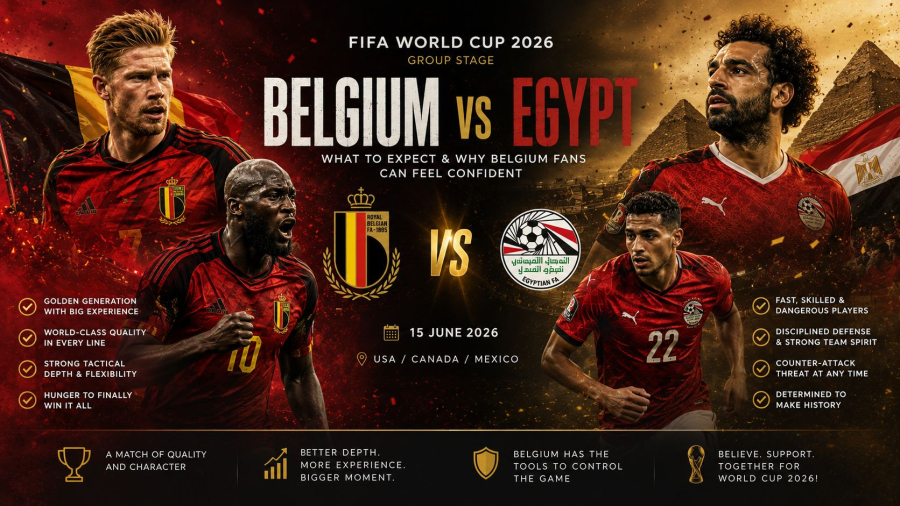
A Belgium vs Egypt matchup at the World Cup would blend two very different football identities: Belgium’s long-running reputation for technical quality and depth against Egypt’s proud tradition of resilience, structure, and moments of brilliance in transition. If these teams meet on the biggest stage, it’s the kind of game that rewards sharp preparation, calm execution, and the ability to turn pressure into clear chances.
From a Belgium-first perspective, there’s plenty to like. Belgium have repeatedly shown they can compete with elite nations over the course of a tournament, including a third-place finish at the 2018 FIFA World Cup. Egypt, meanwhile, have featured less frequently at World Cups (with appearances including 1934, 1990, and 2018), and when they arrive they are often organized and dangerous, but typically asked to do a lot without the ball against top-tier opponents.
This article lays out what to expect if Belgium and Egypt meet at a World Cup: the likely game flow, the tactical pressure points, and the areas where Belgium’s strengths can translate into a decisive advantage.
Setting the scene: what this matchup usually looks like
When a possession-strong European side faces a disciplined team that can defend compactly and counter, a familiar pattern often emerges:
- Belgium typically sees more of the ball, spends longer in the opponent’s half, and looks to create high-quality chances through combination play, wide overloads, and late runs into the box.
- Egypt often aims to stay compact, protect central areas, and attack quickly after regaining possession, especially into space behind advanced full-backs or midfielders.
At a World Cup, where margins are tight and nerves can be high, the team that manages transitions best usually gains the edge. That’s a good headline for Belgium, because when Belgium are at their best, they combine creativity with enough structure to reduce the opponent’s counterattacking opportunities.
Belgium’s built-in advantages (and why they matter)
1) Depth and options to change the game
One of Belgium’s most consistent tournament strengths in recent cycles has been their ability to change the rhythm of a match without changing the overall identity. In a World Cup group game or knockout tie, that matters because not every match is won the same way. Sometimes you need early control. Sometimes you need patience. Sometimes you need a more direct approach.
Against a team likely to defend in numbers, Belgium benefit from:
- Multiple chance-creation routes: wide play, through balls, set pieces, and second-phase attacks.
- Substitution impact: fresh legs and fresh profiles can tilt a stalemate into a win.
- Flexibility in shape: Belgium have often used back-three and back-four structures across different tournaments and coaching eras, giving them tactical adaptability.
2) Chance creation from midfield quality
Belgium’s best periods at major tournaments have been built on high-end midfield and attacking midfield play: players who can receive under pressure, progress the ball, and produce the final pass. Against Egypt, this is crucial because a compact defensive block tries to funnel you away from central zones and into predictable crossing.
Belgium’s edge comes from their ability to still find central pockets and create higher-value shots, not just volume.
3) Experience in high-pressure tournament moments
Belgium’s recent World Cup history includes deep runs and matches against elite opposition. That matters less as a narrative point and more as a practical advantage: players who have lived through knockout-level intensity are often better at managing the emotional tempo of the match, staying patient, and avoiding the kind of rushed decisions that fuel counters.
In tight World Cup games, experience often shows up as:
- Fewer risky passes in vulnerable zones.
- More controlled rest-defense positioning (how the team is set up behind the ball while attacking).
- Better game management in the final 20 minutes.
Egypt’s strengths to respect (so Belgium can plan to win)
Being “for Belgium” doesn’t mean ignoring what makes Egypt dangerous. In fact, the easiest way to feel confident as a Belgium supporter is to understand the threats clearly, because most of Egypt’s best chances tend to come from a small number of repeatable patterns.
1) Counterattacks and direct transitions
Egypt can be at their best when the match becomes a series of quick, decisive moments: win the ball, play forward early, and force defenders to sprint back toward their own goal. Belgium will want to minimize loose touches and poorly structured attacks that leave them open.
2) Individual star power in attack
Egypt have produced world-class attacking talent, with Mohamed Salah being the most prominent modern example. Even when a team has limited possession, one high-quality attacker can create a match-turning moment through a run in behind, a quick combination, or a set-piece situation.
For Belgium, the goal is not to “eliminate” that threat completely (few teams can), but to reduce the frequency and quality of the moments where Egypt’s attackers face a backpedaling defense.
3) Compact defending and discipline
A well-organized block can frustrate even top teams, particularly if the favorite gets impatient. Egypt can make the match feel crowded in central zones, forcing more sideways circulation and more crosses from less dangerous angles.
Belgium’s opportunity here is that compact blocks can also become passive if pinned back for too long. If Belgium keep moving the ball with purpose, eventually the defensive spacing tends to stretch.
What to expect tactically: the most likely game flow
While exact lineups and systems vary from tournament to tournament, Belgium vs Egypt at a World Cup would often trend toward this flow:
- Belgium dominate possession early, testing Egypt’s defensive spacing with switches of play and probing passes.
- Egypt prioritize shape, staying compact and waiting for transition moments.
- The first goal becomes massive: if Belgium score first, the match often opens; if Egypt score first, the game can become more difficult and emotionally charged.
That’s why Belgium’s “process” in the opening 30 minutes matters so much: crisp passing, smart positioning behind the ball, and enough patience to avoid handing Egypt the type of chaotic transition they want.
Key battles that can swing the match toward Belgium
Battle 1: Belgium’s creators vs Egypt’s midfield screen
Egypt’s defensive plan is likely to protect the middle first. Belgium’s plan should be to use movement and rotation to create central access anyway.
Watch for Belgium trying to:
- Pull Egypt’s midfield line sideways with switches and overlaps.
- Create “third-man” runs (pass, layoff, runner receives) to break the screen.
- Attack the space just outside the box for cutbacks and edge-of-area shots.
Battle 2: Wide overloads and the quality of the final ball
Against a compact block, width is often the tool that opens everything else. Belgium can create advantages by committing a winger, a full-back, and a midfielder to one side, forcing Egypt to shift across. The key is what happens next: an early cross into numbers is often low value, while a cutback after reaching the byline or half-space can be far more dangerous.
If Belgium’s wide play produces cutbacks rather than hopeful crosses, Belgium’s chance quality rises significantly.
Battle 3: Defensive transitions (Belgium’s rest defense)
“Rest defense” is one of the least flashy but most decisive concepts in tournament football. When Belgium attack, how many players stay positioned to stop the counter? Are they close enough to press immediately after losing the ball?
If Belgium get this right, they don’t just defend better. They also keep Egypt pinned in, which creates more sustained attacking phases and more chances.
A Belgium-friendly matchup checklist: what needs to go right
If you’re watching as a Belgium supporter, these are the signs the match is trending in Belgium’s favor.
1) Patience without passivity
There’s a difference between controlling the ball and controlling the opponent. Belgium want circulation with intent: moving Egypt, forcing decisions, and regularly arriving in threatening zones. If Belgium are merely passing side-to-side with no penetration, Egypt’s defensive plan is working.
2) Early shots are fine, but the best chances come from inside the box
Against a compact defense, long-range shots can be a useful tool to test the goalkeeper and win rebounds, but Belgium’s biggest moments should come from:
- Cutbacks from the byline.
- Diagonal runs between center-back and full-back.
- Quick combinations just inside the penalty area.
3) Set pieces treated like a weapon
World Cup matches are often decided by corners, wide free kicks, and second balls. Belgium have historically had the physical and technical qualities to make set pieces matter. Against a team that may concede territory, set pieces can become an efficient path to a breakthrough.
4) Smart fouls and clean recoveries to stop counters
Egypt’s most dangerous sequences may come right after Belgium lose the ball. Belgium can protect themselves by:
- Counter-pressing immediately with nearby players.
- Avoiding risky central turnovers.
- Staying balanced with at least a couple of players positioned to delay the break.
Belgium vs Egypt: style comparison (at a glance)
| Category | Belgium (typical strengths) | Egypt (typical strengths) |
|---|---|---|
| Primary game plan | Build-up play, possession control, layered attacking | Compact defending, counters, direct attacking moments |
| Where the danger comes from | Creative passing, wide overloads, cutbacks, set pieces | Transitions, runs in behind, individual attacking quality |
| Key risk | Turnovers that trigger counters | Being pinned back and conceding sustained pressure |
| Ideal match state | Scoring first, controlling tempo, forcing Egypt to chase | Staying level late, or scoring first and protecting the lead |
The Belgium storyline to believe in: control, then strike
Belgium’s most persuasive path to victory in this matchup is not necessarily a frantic, end-to-end contest. It’s a controlled performance that gradually forces Egypt into smaller and smaller margins:
- Belgium keep Egypt’s counters rare and predictable.
- Belgium make Egypt defend wide, then punish gaps centrally.
- Belgium turn territorial dominance into high-quality chances.
It’s the kind of match where Belgium’s quality can feel inevitable when executed well: not because Egypt are weak, but because compact defending becomes harder to maintain for 90 minutes against constant movement and repeated waves.
Players and moments that often decide games like this
Because World Cup squads change over time, it’s safest to focus on roles rather than specific names. In Belgium vs Egypt, these roles tend to be decisive:
The Belgium passer who breaks lines
Every compact defense is built on denying access into the most dangerous spaces. Belgium’s line-breaking passer (often a top-level midfielder or attacking midfielder) is the player who can turn a safe phase into a clear chance with one pass between lines.
The Belgium wide runner who reaches the byline
When Egypt sit deep, the ability to get behind the defensive line matters. A wide player who can time overlapping runs and deliver accurate cutbacks can be the difference between sterile possession and a match-winning chance.
The Belgium finisher who turns half-chances into goals
In tournament football, you might only get a handful of clear looks. Belgium’s top attackers are often defined by their ability to finish efficiently when the opening appears.
The Egypt transition leader
For Egypt, the most influential attacker is often the one who can receive under pressure, carry the ball into space, and either shoot or slip a runner in behind. Belgium’s defensive midfield and center-backs will want to control this zone aggressively but intelligently.
What Belgium fans should watch for in the first 15 minutes
The opening phase can tell you a lot about how the match will unfold. For Belgium, strong early signs include:
- Clean build-up: Belgium playing through Egypt’s first pressure without cheap giveaways.
- Quick recoveries: when Belgium lose the ball, they win it back quickly or force Egypt to clear long.
- Varied attacking patterns: at least one successful switch of play, one byline attempt, and one central combination.
If Belgium are already producing corners, cutbacks, or shots from inside the area early on, it often means Egypt’s block is being stretched sooner than planned.
How Belgium can make it comfortable (the “supporter’s dream” scenario)
The most Belgium-friendly version of this matchup usually looks like:
- Belgium score first (especially before halftime), forcing Egypt to open up at least slightly.
- Belgium keep control after scoring, rather than turning the match into chaos.
- Belgium use fresh legs wisely to maintain tempo and protect against late counters.
Once Egypt need to chase the game, spaces tend to appear. That’s where Belgium’s technical quality and passing range can create the clearer chances that decide a World Cup tie.
Common turning points to be ready for
Even in matches where Belgium control most of the play, there are predictable moments where the game can swing. Knowing them makes the viewing experience clearer (and, often, calmer).
A sudden Egypt break after a Belgium set piece
Corners and wide free kicks are double-edged: they can create goals, but they can also create counters if the clearance falls kindly. Belgium’s positioning and counter-press after set pieces is a key detail.
A spell of Belgium pressure without a goal
Against a deep block, you can do many things right and still be 0–0 after 60 minutes. Belgium’s advantage is that if they keep producing quality entries and avoid transition mistakes, the breakthrough chance often arrives.
A late-game moment of individual quality
World Cup matches are frequently decided by a single touch: a through ball, a first-time finish, a defensive lapse, or a set-piece header. Belgium’s depth and technical quality give them multiple routes to create that decisive moment.
Bottom line: what to expect, and why Belgium should back themselves
If Belgium and Egypt meet at the World Cup, expect Belgium to have more of the ball and to spend more time probing a compact defense. Expect Egypt to aim for a disciplined performance built on organization and fast transitions, with the capacity to threaten through individual attacking quality.
From a Belgium-forward point of view, the reasons for confidence are clear and practical:
- Belgium’s tournament pedigree in recent World Cups shows they can handle big moments and high-level opponents.
- Belgium’s attacking variety gives them multiple ways to break down a compact block.
- Belgium’s ability to control phases can reduce Egypt’s best weapon: transitional chaos.
Do the simple things well, stay patient, and treat every transition as a moment that matters, and this is a matchup where Belgium’s quality can translate into a result that feels both deserved and convincing.
Quick fan takeaway: the Belgium game plan in one sentence
Control the ball with purpose, protect against counters, and turn wide pressure into central cutbacks and set-piece dominance.
That formula is exactly the kind of World Cup football Belgium are built to deliver.
